
So it’s my last post.* I won’t go into the obvious stuff like the culture shock (airport bathrooms in D.C. with auto water, soap, and towel…needless to say running water!), or even how blessed I feel to be from this great country of ours. And I’m not even going to talk about poverty.
That’s because poverty is not what this fellowship was about. It never was intended to be, but I didn’t know that at the beginning. Thinking back to Bangladesh, I can recall sitting in one of the few modern cafés of Dhaka, racking my brain over tea after tea, trying to figure out what I was going to produce from this fellowship. What tangible thing was going to be the outcome? Along the way I would explain to expats what I was doing, and of course, one of their first questions would be, “So what do you have to do? Is this for a degree? Do you have to write a report?” When I told them, no, I only had to blog, they didn’t get it. Their next question was, “No, I mean, don’t you have turn something in?”
Even though I knew I didn’t have to create anything, I still, for some reason, felt I did.
And so, I sat in Dhaka, thinking that if I was going to do something, it needed to be comparative and a consistent theme, and so it needed to start here, country number one. Would it be a book? A photo journal? What would be the angle? Mega slums? Social enterprise? Big aid? The fellowship proposal I had written seemed like a guideline enough when I composed it, but now that I was actually carrying it out on the ground, it became more of a tenuous concept than a clear roadmap. Time was running out – I had to leave Bangladesh soon.
I was consumed with self-doubt. I really couldn’t think of anything – I was interested in all the areas of poverty and all the areas of development. Since I knew I wouldn’t be able to cover it comprehensively, I couldn’t tie it together. Here I was, I felt, with this golden opportunity that so many people would kill to have, and it looked like, if I didn’t act soon, I was just going to wing it.
And that’s pretty much what I did.
I tried to set things up along the way in terms of volunteering or some sort of network in each country of which I could be a part, but these plans really had no consistent theme except it was all stuff I was just really interested in. Often, such as in South Africa, I would just hitchhike around a country doing outdoors activities or, like in Zimbabwe, I’d just walk up to the border and see if I could get across to talk to people and see what was going on with the farmer situation.
This is when I started to think. Smashed between sweating Malawians in the back of a minibus that never seemed to move. Speeding through rice fields in southern China on a mountain bike under clear blue skies. Spending New Year’s Eve alone in northern Mozambique, knowing really no one in the city. Though not all of these were the most pleasant experiences, they are some of my fondest memories.
It was during times like these that I really started to understand myself and how I see the world, as cliché as it sounds. My thoughts rather exploded – I had scraps of paper with ideas to explore and write about a later date when I was not traveling. Even now, back home and not completely back in the mix, my corkboard has become a holding pen for notes bearing one random thought or another.
All throughout college, and my life in fact, I’d been producing, pushing, trying to get to the next level. College entrance. Scholarship applications. Getting internships. Admission to societies. Meeting after meeting. Rinse and repeat.
But I never really stopped to think about what it all meant, or how I fit into the bigger picture. Of course, much of this was self imposed, but I’d wager to say that many people, especially those at top-20 colleges, have had similar experiences at some point. A lot of this, I think, has to do with the way the system is set up: to value lines on a resume much more than creative thought.
When I got back Stateside, I was able to catch up with the other Keegan Fellow from my year, Kathryn Moreadith. It was shocking how similar our reflections were. Talking over Skype, the essence of our conversation was as if we were both saying, at the same time, “Can you believe what just happened?! It never was supposed to be about the project!” The creeping feeling of failure that I felt, even after I was back, was something she could understand. But now, having had time to reflect, that feeling of failure is gone. I realize I’ve succeeded in ways valuable beyond measure.
*I will technically post a few more of my thoughts from the trip on my main fellowship site. In fact, I’ve already published one about Chinese social enterprise, a piece I was working on while abroad but never published. Go here to see this first piece.


 In my small hometown, in terms of infrastructure and specifically roads, city officials often consider things like whether to repave a road, install a roundabout in place of a stoplight, or alter speed limits. Rural Liberians in Bong County were faced with a similar dilemma on a slightly larger scale: their government, out of lack of will or capacity, had failed to provide a road connecting their villages to the city. I talked with Amos Mulbah, one of the villagers (not the Amos previously mentioned) who explained the problem was that pregnant women had to endure many pains over the footpaths that made villages accessible only by foot or motorcycle. Yea, I think a road connecting my home to modern civilization is probably pretty important, too.


 They expect their government to provide the infrastructure and social services – that they were vocal about. But given these examples of collective initiative, it seems they understand the nation has just emerged from years of war and recovery will be slow. In the meantime, they can help too.


 The villagers need agricultural business to start up, and it’s starting to happen in Liberia. Attracting large commercial investors can be a powerful way to grow an economy and help people like James, but if property rights and cultural traditions aren’t respected when business comes, as


 I’ve often explained to people the potential for African agriculture. After working on the farm for just a few weeks, that only becomes clearer. It is true that Africa has a more difficult agricultural environment than places like Latin America and infrastructure such as roads is lacking. But it’s also true that there are opportunities in terms of increasing yields and increasing the amount of land that those yields are on. Right now


 of modern civilization), we were in solid bush. The village was Boi Town. I hopped out of the back, and met Togbah, a short, scruffy old man with graying hair, a strained face, and condemning eyes that were initially hidden behind a big grin and welcoming attitude (pictured in orange shirt). He insisted I call him his Papa (pronounced “Pap – A”), as he was known in the village as the Papa. My things were dropped off at his house, which was quite impressive, and then we walked to his farmhouse, five minutes away. His daughters were pounding rice and his wife was busy at the fire. From his farmhouse we made stops at every home and person, introducing me. Finally we came to the village “restaurant” that serves breakfast and lunch, run by the wife, Framadah, of Togbah’s younger brother Amos.


 level, due to the schools shutting down in most areas during the war – 12 year-olds in 1st grade, 20 year-olds in 5th grade, etc. I had the chance to visit the University of Liberia for the day, arguably the country’s best university. The teaching was, in my opinion, pretty subpar, though the professors may not have been at fault. It seemed like they were reading a lot of definitions for the students to copy down, something they should have covered in their preparation. But then I found out that books were too expensive for the majority of students to purchase. One of the interesting things I saw was that they were covering indifferent curves in their economics classes; granted it was something I learned in my first year at Vanderbilt while they were just getting to it as juniors, but they were covering it nonetheless. Now that schools are back open, the classes are heaving. The classes I saw were spilling out into the pathways, and students searched for anywhere to sit, while those less lucky had to stand for the lectures. Large populations of students are pressed into a limited number of schools – roughly 70% of schools were damaged or destroyed during the war, and 35%, of the whole population has never attended school, according to the Poverty Reduction Strategy Paper. Until education improves, it’s unlikely that many of the top jobs in these big MNC’s like BHP Billiton will be able to go to Liberians.
 After an epic two-day overland trip involving motorcycles through the bush, creaking minibuses aboard which I garnered the name “Obama”, sleeping in a village at the border, and over 20 police checkpoints (and 4 forced bribes on the Cote d’Ivoire side), I found myself in Monrovia. If the capital city sounds vaguely presidential, it’s because Liberia is one of only two African countries with American ties (the other being Ethiopia).
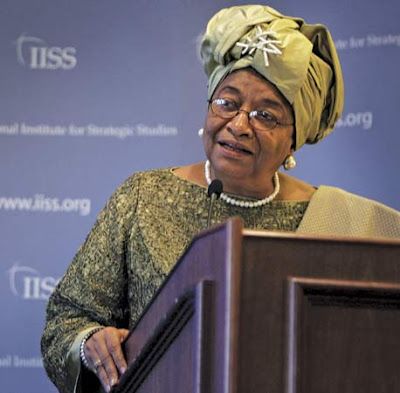 physical guts of the country, but the human capital. Over 1 million people fled from a country that only has 3 million to begin with, and as of 2005 half of those remained to be repatriated. Many are educated Liberians. On a flight, I happened to sit next to one, who had left before the war and only been back three times to see his grandparents. He said something interesting about Red Light, an area in Monrovia with which I was familiar, and which was notorious for muggings. It’s one of the trashiest places in the city – the side of the road seems like a soggy landfill. Being in Africa for nearly a year, I dismissed this as just another African street, but he explained in 1980, when he left, it was never like this. Liberia, he said, was like “the United States of Africa”. It was one of the shining stars of Africa, years ahead of now prominent countries like Ghana.
 Mama Ellen, as she’s affectionately called, is known for being a tireless worker, even at age 72. I had the opportunity to have dinner with one of the directors of Liberia’s


 Posts


